Auto Repair Shop Books Cleanup

Free ticket split

Auto repair shop books cleanup. Split the one-price ticket.

Four taps. Name the line the ticket hid.

Labor, materials, and the time beside them.

Question 1 of 4

Which line on the ticket is mixed?

Question 2 of 4

Where should the parts cost come from?

Question 3 of 4

What else is sitting on the counter?

Question 4 of 4

When should this month stop moving?

Your ticket split can start. Where should we reach you?

    You will be talking to the Steven Palmieri practice.
    Next you pick a time for a free video call with the Steven Palmieri practice. Nothing to sign, nothing to pay.

    Prefer to read first? It's all below ↓

    Auto Repair Shop Books Cleanup Split labor from parts before the close

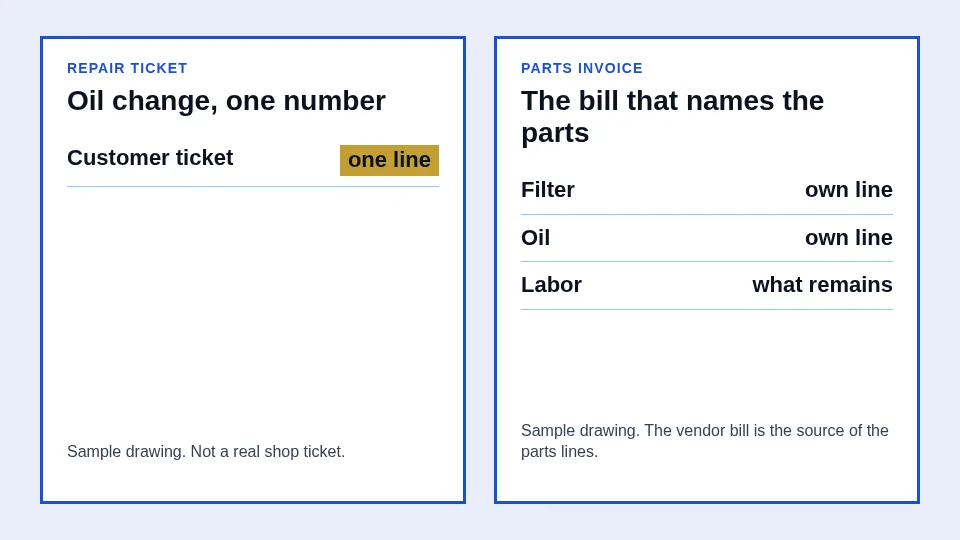
    An oil change billed as one number still has a filter, oil and time behind it, and your books should say so. We sort the repair order before the month is trusted, close the month, and prepare the return only from months that have closed. Steven Palmieri does that sort on the call, in the Tax CFO role owners know as the Entrepreneur's CFO.

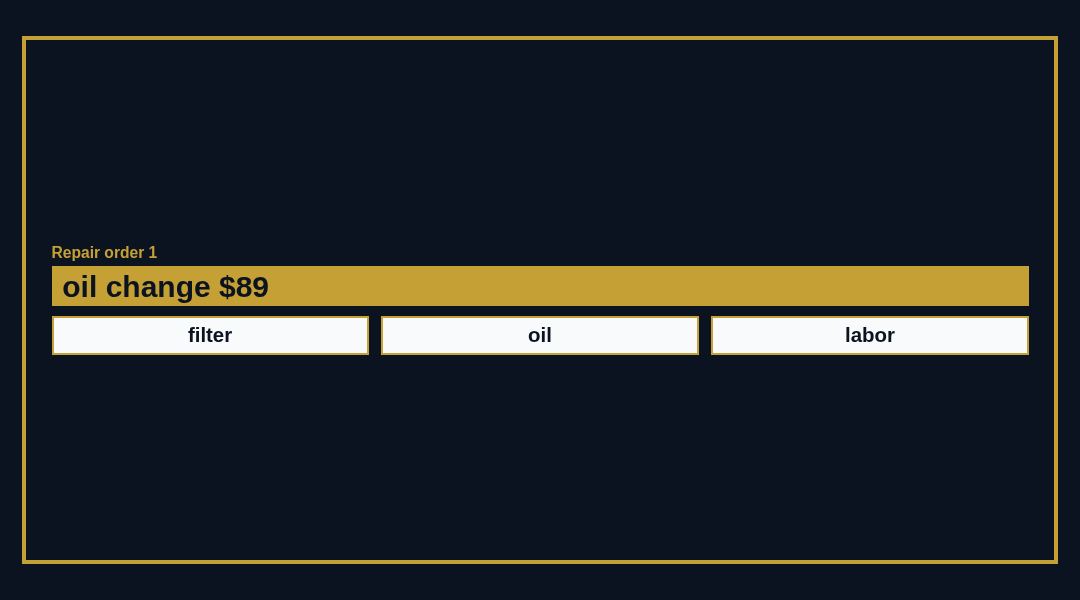
    auto repair shop books cleanup typed with a blinking cursor, then an oil change at 89 dollars splits into filter, oil and labor.
    Name the line

    Name the mixed line

    Steven Palmieri, Tax CFOYou will be talking to the Steven Palmieri practice.
    A repair order the Tax CFO can price from the split.

    A cleanup splits last year's tickets. The Tax CFO splits the ticket and then reads what it says: labor margin that was hiding, parts that were never marked up, a sublet that was never passed through. One counts what happened. The other decides what happens next, like the price of the next brake job.

    How each line still splits

    One price. The vendor bill already names the parts. We pull them out of the time.

    Labor and parts. The advisor wrote two lines. The day-end summary posted one.

    Rags and a wrench. A wrench the shop still owns next year is not a rag. Rags are used up this month. A wrench you still own next year is not an expense this month.

    A maker-paid claim. The customer paid nothing and the maker paid you. That is income with its own line.

    Work another shop did. The customer paid your counter. The other shop still has to be paid.

    Miles after the switch. July changes the cents on the same truck, and the log has to change with it.

    Six repair orders flip past, and each mixed line splits into gold lines.

    Six troubles on a repair order.

    Open one card.

    1. 1One price on an oil change

      We separate the filter and the oil from the time.

      The vendor bill names those parts. Whatever is left on that ticket is the labor.

    2. 2Parts buried in labor

      We put the rotor on its own income line.

      A brake job that already has two lines should not be merged into one sales number.

    3. 3A torque wrench booked as supplies

      We ask whether the shop will still own it next year.

      Rags leave with the job. A wrench that stays on the wall is equipment.

    4. 4Warranty paid by the maker

      We look for a receivable from the maker, not a second sale.

      The customer ticket can be zero and the claim can still be real.

    5. 5Alignment done by another shop

      We keep the sublet apart from the shop's own labor.

      The customer paid the counter. The other shop still has to be paid.

    6. 6Service-truck miles after July 1

      We use the rate that starts on that date.

      A log that keeps the first-half rate through December is the wrong rate for the second half.

    Name the trouble.

    What a card says

    Open one trouble. Each card says what we look for on that kind of ticket.

    Glasses rest on a printed sheet whose columns are labeled labor, materials and expenses

    Who closes the month.

    What the card is for

    Steven Palmieri closes the shop month.

    A shop owner who wants the ticket split is writing to Steven Palmieri, Tax CFO and the Entrepreneur's CFO, and the rest of this card is the repair order rather than a biography. The books, the reconciliation, and the return from months already closed are the work. Getting pay ready happens on the company the shop already uses, and the pay run stays in that company's hands.

    What to bring to the close

    Bring one repair order and we will say what the close still needs.

    Bring one repair order

    Steven Palmieri, Tax CFOYou will be talking to the Steven Palmieri practice.
    A car inside an open service bayAn engine on a stand in a shop

    Four amounts, then the month

    What the four amounts are

    A repair order that can be trusted shows labor, parts, the tax the shop collected, and the deposit the bank actually received. Mix any two and the month can look finished while the margin is still a guess.

    The longer notes sit in the rows under this picture. A closed row can stay closed, and the reason waits inside it.

    What the vendor bill is for

    What someone agreed at the counter is a selling price. What the parts house charged is cost. They are different numbers. When a ticket is entered as one sales amount, the filter, the oil, and the rotor never become a cost, and the labor looks as if it earned the whole sticker.

    We start from the bill that names the part. The rest of that ticket, once the part is lifted out, is the time. If the bill is missing, the line stays open. We do not invent a parts cost to make the month look split. The page on a single price walks through an oil change. The page on labor and parts walks through a job that was already written as two lines.

    The first screen asks only which line on the repair order is mixed, then a name, a phone, and an email. Revenue size and the date of the last closed month stay on the later form, because a bay owner should see the ticket before being asked for a year of context.

    Where the deposit disagrees

    A card batch is not the same object as a repair order. The processor keeps a fee, a tip jar is not a thing in most bays, and a deposit can land the morning after the work. The close has to say which rule the shop uses. Either the ticket stays in the day it was written, or it moves to the day the cash arrived. Pick one and keep it. Switching in the middle of a month is how a deposit gets counted twice.

    The tax the ticket called tax is not part of that income. It sits as an amount collected until it is sent to the state where the shop sits. A percent would belong to the state where the bay sits, and it moves, so these pages leave the percent off. What we keep is the line. Tax collected is its own note. The month itself is the list of what has to agree.

    What the first call needs

    One repair order is enough. We want the ticket, the vendor bill if there is one, and the deposit that is supposed to match. We do not need a year of files to say whether labor and parts are sharing a line. If the month was entered as a single sales number and a single deposit, we say so, and we do not paint a split the tickets cannot support. That case has its own page on a mixed month.

    After that call the work is the monthly close, the reconciliations, the statements, pay set up on the company the shop already hired, and the return that waits until those months are closed. The pay run stays in that company's hands. Audit, review, and compilation requests are handed to a firm whose signature those reports allow. Everything this practice refuses is spelled out on the disclosures page.

    A rate that changes in July

    A service truck is not a customer car, and the miles are not a repair order. IR-2026-29 and Announcement 2026-11 put the business mile at 76 cents on July 1, after IR-2025-128 and Notice 2026-10 have held it at 72.5 cents through June 30. A log that uses one rate for the whole year misstates the second half. Commuting does not go in the log. The shop page for the switch is July miles.

    A wrench is a different question from a mile. Shop rags are supplies. A tool the shop will still own next summer can be equipment, and the election that expenses it is made on the return, not by the way the bill was coded in the books. Rags and tools and the election keep those two moments apart.

    What we leave off the page

    No customer name, no counter total, and no town appear in these examples. A bay here is any bay. An oil change, a brake job, a belt on the shelf, a claim the maker pays, and an alignment another shop performed are composites. They are useful because parts cost and labor income are different even when a state taxes both the same way.

    Any cents or ceiling printed here carries the name of the government page it was copied from. Mileage cents name the notice for that half of the year. An expensing ceiling names Revenue Procedure 2025-32. An information-return threshold names the instructions for that form. No publisher, no number. The sketch with the dollars left off is on the shape.